
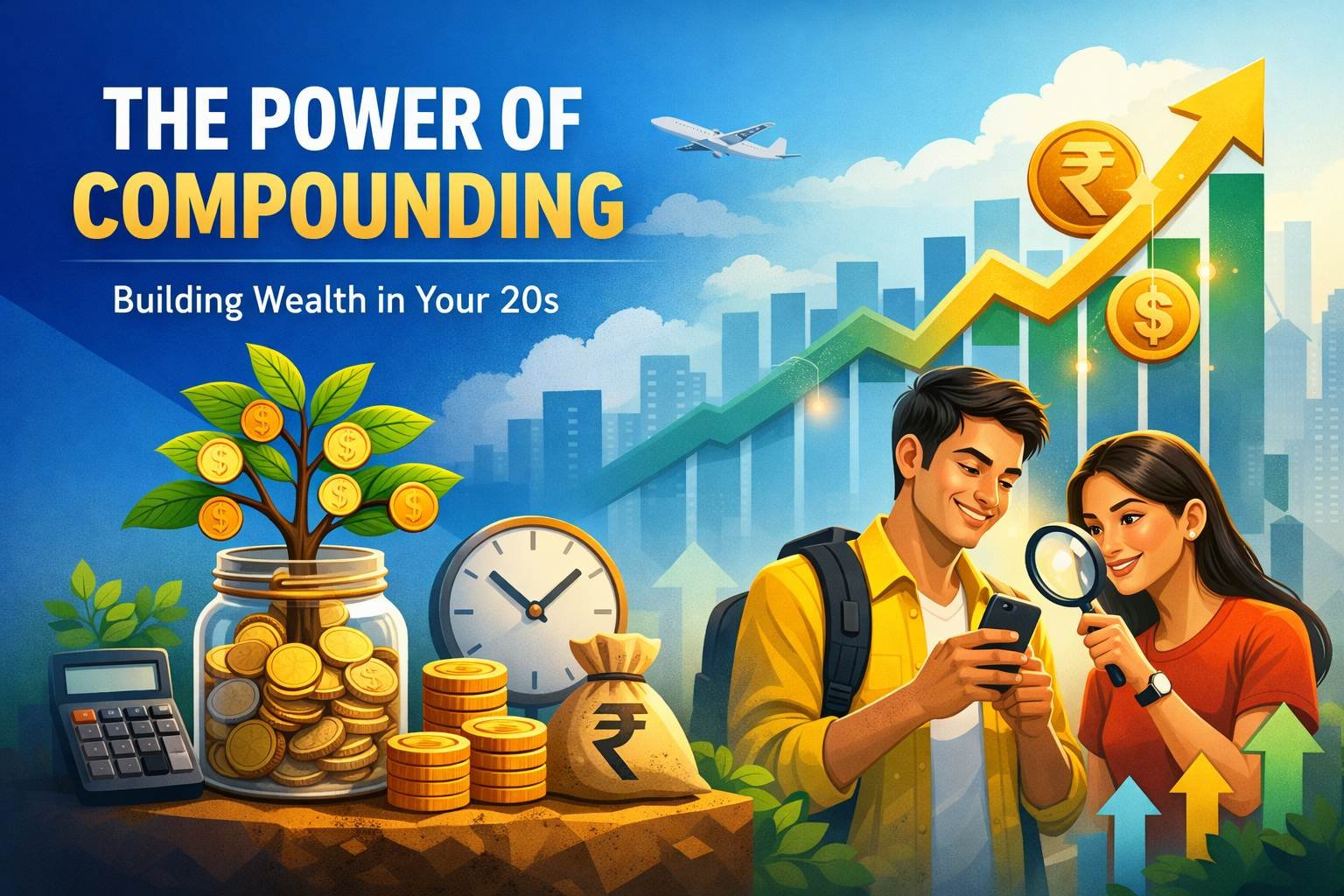
Most people in their 20s are busy just trying to survive adult life. New jobs, unstable income, rising rent, student loans, family expectations, and the pressure to “enjoy life” all compete for attention. In this chaos, financial planning often feels like something meant for later—your 30s or 40s.
But here’s an uncomfortable truth: every year you delay understanding compounding is a year of invisible wealth lost forever.
The power of compounding doesn’t scream for attention. It works quietly, slowly, and patiently. That’s exactly why most people ignore it—until it’s too late.
This guide explains what compounding really is, why it matters more in your 20s than at any other age, and how ordinary people—students, freshers, freelancers, and young professionals—can use it to build long-term financial security.
Table of Contents
- Understanding the Power of Compounding
- Why Time Is More Valuable Than Money
- How Compounding Actually Works
- Compounding Through Real-Life Examples
- Compounding in the Indian Financial System
- Beyond Money: Compounding in Career & Life
- The Dark Side: What Breaks Compounding
- How 20-Somethings Can Start Today
- Long-Term Mindset for Sustainable Wealth
- Conclusion
- FAQs
Understanding the Power of Compounding
At its core, compounding means growth on top of growth.
Unlike simple interest, where returns are calculated only on the original amount, compounding allows your returns to earn returns. Over time, this creates a snowball effect.
Albert Einstein famously called compound interest the “eighth wonder of the world.” Whether or not he actually said it, the idea holds true.
Simple Explanation
- Year 1: You invest money
- Year 2: You earn returns
- Year 3 onwards: Returns earn their own returns
The longer you stay invested, the less effort you need to put in for growth.
Why Time Is More Valuable Than Money
One of the biggest myths around investing is that you need a lot of money to start. In reality, you need time far more than capital.
Time Multiplies Effort
A person investing a small amount for 30 years often ends up with more wealth than someone investing double the amount for 15 years.
That’s because compounding accelerates in later years.
Think of it like a plane:
- The first few minutes feel slow
- Once airborne, speed increases rapidly
Your wealth behaves the same way.
How Compounding Actually Works
The Early Years Feel Disappointing
This is where most people quit.
For the first few years:
- Growth feels slow
- Returns look insignificant
- You question whether it’s worth it
But compounding isn’t linear. It’s exponential.
The Breakthrough Phase
After enough time:
- Growth accelerates
- Returns exceed your contributions
- Wealth feels “automatic”
This is when compounding becomes visible—but only for those who stayed patient.
Compounding Through Real-Life Examples
Example 1: Two Friends, Two Decisions
- Amit (age 23) invests ₹4,000/month until age 60
- Rohit (age 33) invests ₹8,000/month until age 60
Despite investing half the amount, Amit ends up with significantly more wealth due to a 10-year head start.
👉 Time beats intensity.
Example 2: Missed Opportunity Cost
Skipping investment in your 20s doesn’t just delay wealth—it permanently reduces it.
You can’t “catch up” later, because lost time cannot be recovered.
Compounding in the Indian Financial System
India offers several powerful compounding tools that many young people ignore.
SIPs (Systematic Investment Plans)
SIPs allow you to:
- Invest small amounts regularly
- Avoid timing the market
- Build discipline
Even modest SIPs grow substantially over decades.
EPF, PPF & NPS
- EPF quietly compounds through employer + employee contributions
- PPF offers tax-free compounding
- NPS benefits long-term retirement planning
These instruments aren’t exciting—but they’re effective.

Beyond Money: Compounding in Career & Life
Compounding isn’t limited to finance.
Skills Compound Too
Learning one skill deeply in your 20s:
- Improves income
- Creates leverage
- Opens opportunities
Writing, coding, design, communication, data analysis—skills compound faster than salaries.
Habits Compound Daily
- Reading daily → knowledge wealth
- Exercising regularly → health wealth
- Saving first → financial stability
Tiny daily actions create massive long-term change.
The Dark Side: What Breaks Compounding
Many people sabotage compounding unknowingly.
Common Mistakes
- Chasing quick profits
- Frequently switching investments
- Emotional decisions during market crashes
- Lifestyle inflation after salary hikes
- Waiting for “perfect conditions”
Compounding demands boring consistency, not excitement.
How 20-Somethings Can Start Today
You don’t need expertise. You need action.
Simple Starting Framework
- Start investing with any amount
- Automate contributions
- Increase investments gradually
- Stay invested long-term
- Ignore daily market noise
The goal isn’t maximum returns—it’s maximum consistency.
Long-Term Mindset for Sustainable Wealth
Wealth built through compounding feels slow initially, then unstoppable later.
People who win financially:
- Think in decades, not months
- Focus on systems, not shortcuts
- Let time do the heavy lifting
Your future isn’t built by dramatic decisions—but by quiet, repeated ones.
Conclusion
The power of compounding is one of the few advantages young people have that cannot be replaced later.
You don’t need to earn more.
You don’t need perfect knowledge.
You just need to start early and stay consistent.
Your 20s are not for perfection—they’re for planting seeds.
FAQs
1. Is compounding guaranteed?
Returns aren’t guaranteed, but time increases probability of success.
2. How early should I start investing?
As soon as you earn your first income.
3. Is compounding useful without stock markets?
Yes. Skills, habits, and savings compound too.
4. Can I start with irregular income?
Yes. Flexibility matters more than amount.
5. What’s the biggest enemy of compounding?
Impatience.