
Most of us start our journey of self-improvement with big dreams. We promise ourselves dramatic changes — waking up at 5 AM, exercising every day, quitting bad habits overnight, or mastering a new skill in 30 days. For a few days, motivation feels high. Then life happens. Motivation fades, routines break, and guilt takes over.
But what if real transformation doesn’t require dramatic change at all?
What if the secret to success, happiness, and personal growth lies in becoming just 1% better every day?
This simple idea has helped athletes, students, professionals, and entrepreneurs worldwide achieve extraordinary results — not through intensity, but through consistency.
Table of Contents
- What Does “1% Better Every Day” Really Mean?
- The Science Behind Small Improvements
- Why Small Changes Are More Powerful Than Big Goals
- Real-Life Examples of 1% Growth
- How to Apply the 1% Rule in Daily Life
- Health & Fitness
- Career & Skills
- Money & Finance
- Mental Health & Mindset
- Common Mistakes to Avoid
- How to Stay Consistent Without Burning Out
- Conclusion: Progress Over Perfection
- FAQs
What Does “1% Better Every Day” Really Mean?
The idea of getting 1% better every day means making tiny, manageable improvements consistently rather than chasing instant results.
If you improve by just 1% daily, the compound effect is powerful. Over a year, those small gains add up to nearly 37 times improvement. On the other hand, ignoring small habits can slowly push you backward without you even noticing.
This concept focuses on:
- Systems over goals
- Daily actions over motivation
- Long-term growth over short-term wins
It’s not about being perfect. It’s about being slightly better than yesterday.
The Science Behind Small Improvements
Behavioral science and psychology strongly support the power of small habits.
Key reasons why small changes work:
- Lower resistance: Small actions don’t trigger fear or procrastination.
- Habit formation: Repeating tiny behaviors builds long-lasting habits.
- Confidence boost: Small wins create momentum and self-belief.
- Less burnout: You grow without exhausting yourself.
Neuroscience shows that consistent small actions rewire the brain, strengthening neural pathways related to discipline, focus, and confidence.
Why Small Changes Are More Powerful Than Big Goals
Big goals can be inspiring, but they often fail without systems.
Big goals fail because:
- They rely heavily on motivation
- Progress feels slow and discouraging
- One failure leads to quitting
Small improvements succeed because:
- They are easy to start
- They fit into busy lives
- Missing one day doesn’t destroy progress
Think of success as interest in a bank account. You don’t become rich overnight, but consistent deposits change everything.
Real-Life Examples of 1% Growth
Example 1: Fitness
Instead of committing to 1 hour of gym daily, someone starts with:
- 5 push-ups a day
- 5-minute walks
- One healthy meal choice
Within months, fitness becomes part of identity — not a struggle.
Example 2: Learning a Skill
A student who studies:
- 15 minutes daily
will outperform someone who studies 3 hours once a week.
Consistency beats intensity every time.
Example 3: Writing or Blogging
Writing just:
- 200 words a day
results in over 70,000 words a year — enough for a book or a high-traffic blog.
How to Apply the 1% Rule in Daily Life
1. Health & Fitness
You don’t need extreme workouts or strict diets.
Try:
- Drinking one extra glass of water daily
- Taking stairs once a day
- Stretching for 2 minutes before bed
Small health habits compound into long-term wellness.
2. Career & Skills
Whether you’re a student or a professional, skill growth matters.
1% improvements can include:
- Reading 2 pages daily
- Watching one educational video
- Practicing one interview question
- Learning one new shortcut or tool
Over time, you become noticeably more skilled — without stress.
3. Money & Finance
Financial growth isn’t about sudden wealth.
Start small:
- Track one expense daily
- Save ₹50 a day
- Learn one finance concept weekly
- Reduce one unnecessary expense
These habits improve money awareness and long-term security.
4. Mental Health & Mindset
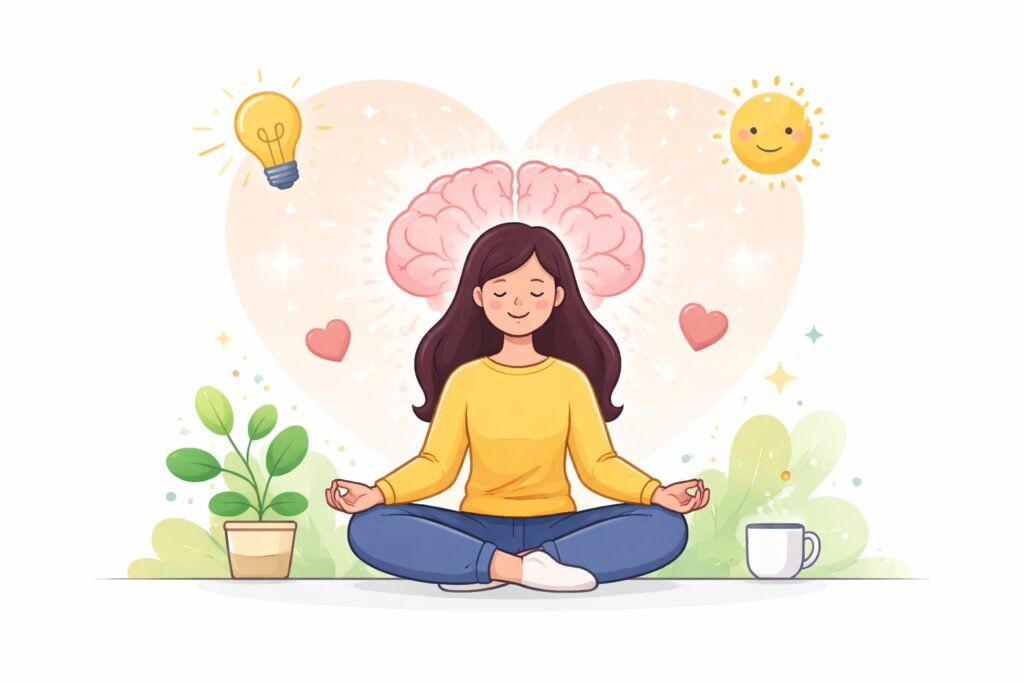
Mental peace grows through tiny practices.
Examples:
- Writing one gratitude point daily
- Taking 3 deep breaths during stress
- Reducing social media by 5 minutes
- Replacing negative self-talk with one positive thought
Mental strength is built quietly, not dramatically.
Common Mistakes to Avoid
Even small habits can fail if approached wrongly.
Avoid these mistakes:
- ❌ Trying to improve everything at once
- ❌ Expecting fast visible results
- ❌ Being harsh on yourself for missed days
- ❌ Comparing your journey with others
Remember, progress is personal.
How to Stay Consistent Without Burning Out
Consistency is the real challenge — not ability.
Practical tips:
- Attach new habits to existing routines
- Track progress visually (calendar or checklist)
- Focus on “never miss twice”
- Celebrate effort, not just results
- Reduce goals on bad days, don’t skip them
Even showing up at 10% effort keeps the habit alive.
Conclusion: Progress Over Perfection
The idea of getting 1% better every day is simple, but deeply powerful. It shifts focus from pressure to progress, from outcomes to actions.
You don’t need a perfect plan, unlimited motivation, or major life changes. You only need the willingness to take one small step today — and repeat it tomorrow.
Because when small changes become daily habits, transformation becomes inevitable.
To help your move from theory to action, here is a structured sample 30-Day “1% Better” Challenge. This checklist is designed to be low-friction but high-impact:
The 30-Day 1% Challenge Checklist
Week 1: The Foundation (Physical & Mental Reset)
Focus: Removing friction and preparing your environment.
- [ ] Day 1: Drink 500ml of water immediately upon waking up.
- [ ] Day 2: Unsubscribe from 5 junk email newsletters that clutter your brain.
- [ ] Day 3: Take a 10-minute walk without your phone or headphones.
- [ ] Day 4: Identify your “One Big Thing”—the one task that makes everything else easier.
- [ ] Day 5: Organize your digital desktop; delete or folder 10 old files.
- [ ] Day 6: Replace one sugary drink today with plain water or herbal tea.
- [ ] Day 7: Go to bed 15 minutes earlier than your usual time.
Week 2: Building Momentum (Micro-Habits)
Focus: Proving to yourself that you can show up.
- [ ] Day 8: Read exactly 5 pages of a non-fiction book.
- [ ] Day 9: Do “The 2-Minute Drill”: Spend 2 minutes on a task you’ve been procrastinating on.
- [ ] Day 10: Practice “Box Breathing” (4s inhale, 4s hold, 4s exhale, 4s hold) for 3 rounds.
- [ ] Day 11: Write down 3 things you are genuinely grateful for.
- [ ] Day 12: Set a “Phone Bedtime”—no screens 30 minutes before sleep.
- [ ] Day 13: Perform 5 minutes of basic stretching or mobility work.
- [ ] Day 14: Review your last week’s spending; find one unnecessary expense to cut.
Week 3: Skill & System Optimization
Focus: Sharpening the saw and improving your workflow.
- [ ] Day 15: Learn one new keyboard shortcut for a tool you use daily (Excel, Canva, etc.).
- [ ] Day 16: Spend 10 minutes researching a topic outside your career field.
- [ ] Day 17: Practice “Active Listening”: In your next conversation, don’t interrupt once.
- [ ] Day 18: Declutter your physical workspace; a clean desk is a clean mind.
- [ ] Day 19: Try “Batching”: Group all your small errands into one 60-minute block.
- [ ] Day 20: Write a “To-Don’t” list: 3 things you will stop doing today.
- [ ] Day 21: Reach out to a mentor or peer and offer a genuine compliment or thank you.
Week 4: The Compound Effect (Refinement)
Focus: Deepening your commitment and looking ahead.
- [ ] Day 22: Increase your workout intensity or duration by just 1%.
- [ ] Day 23: Spend 15 minutes planning your entire upcoming week.
- [ ] Day 24: Practice “Deep Work”: Set a timer for 25 minutes of zero-distraction focus.
- [ ] Day 25: Reflect on a recent mistake; write down one lesson learned.
- [ ] Day 26: Update your LinkedIn profile or Portfolio with one new achievement.
- [ ] Day 27: Eat your largest meal today without any digital distractions (no TV/Phone).
- [ ] Day 28: Meditate for 5 minutes; focus only on the sensation of your breath.
- [ ] Day 29: Tidy up your “Social Circle”: Mute or unfollow 3 accounts that make you feel negative.
- [ ] Day 30: The Review: Look back at Day 1. Write down how much easier these habits feel now.
How to Use This Checklist
Reward Progress: After finishing Week 2, treat yourself to something small that supports your growth, like a new book or a healthy meal.
The “Never Miss Twice” Rule: If you miss a day, don’t worry! Just make sure you don’t miss the next one.
The “Floor” Strategy: If a task feels too big, lower the bar until it’s impossible to say no. (e.g., If 10 minutes of walking is too much, walk for 1 minute).
FAQs
1. Is 1% improvement really enough to change life?
Yes. Small daily improvements compound over time and create massive long-term transformation without overwhelming effort.
2. How long does it take to see results?
Some results appear in weeks, but real transformation happens over months through consistency and patience.
3. What if I miss a day?
Missing one day doesn’t matter. Missing many days in a row does. Focus on restarting immediately.
4. Can this method work for students and professionals?
Absolutely. The 1% rule works for learning, productivity, health, finances, and personal growth.
5. How do I choose what to improve?
Start with one area that matters most right now — health, skills, or mindset — and make it easy.
For more latest post focus on trendepost.com